In 2022, I was asked to run the introduction to Leadership training series for frontline managers at StackAdapt. Below, is what I presented:
—
Good morning team! How’s everyone doing today? I am really excited to spend the next hour together!
We are building internal capacity to help new managers become successful in their roles and as part of new manager training, I was asked to take the topic of leadership as a way to kick of the training.
As I am sure you all know, I co-founded this company with Ildar and Yang in my kitchen [12] years ago, and have since grown it to almost a [1,800] person strong global team we have today. In this process, I have had to grow a lot as a leader - and I expect I still have a lot more growing to do as our company becomes larger and more complex.
Despite this, I never actually taught leadership to others. So in creating this lecture, I had to do a lot of hard introspection and reflection to understand what exactly do I want to teach you. This meant I had to think about, distill, and categorize, the lessons I have learned about leadership over the years. Since this this is my very first time teaching this topic, I am sure even in the process of teaching you today I will learn a ton. So thank you for giving me this opportunity to learn!
I really think growing as a leader is a never-ending journey of self-improvement, and I’m grateful to be alongside you all on this journey today.
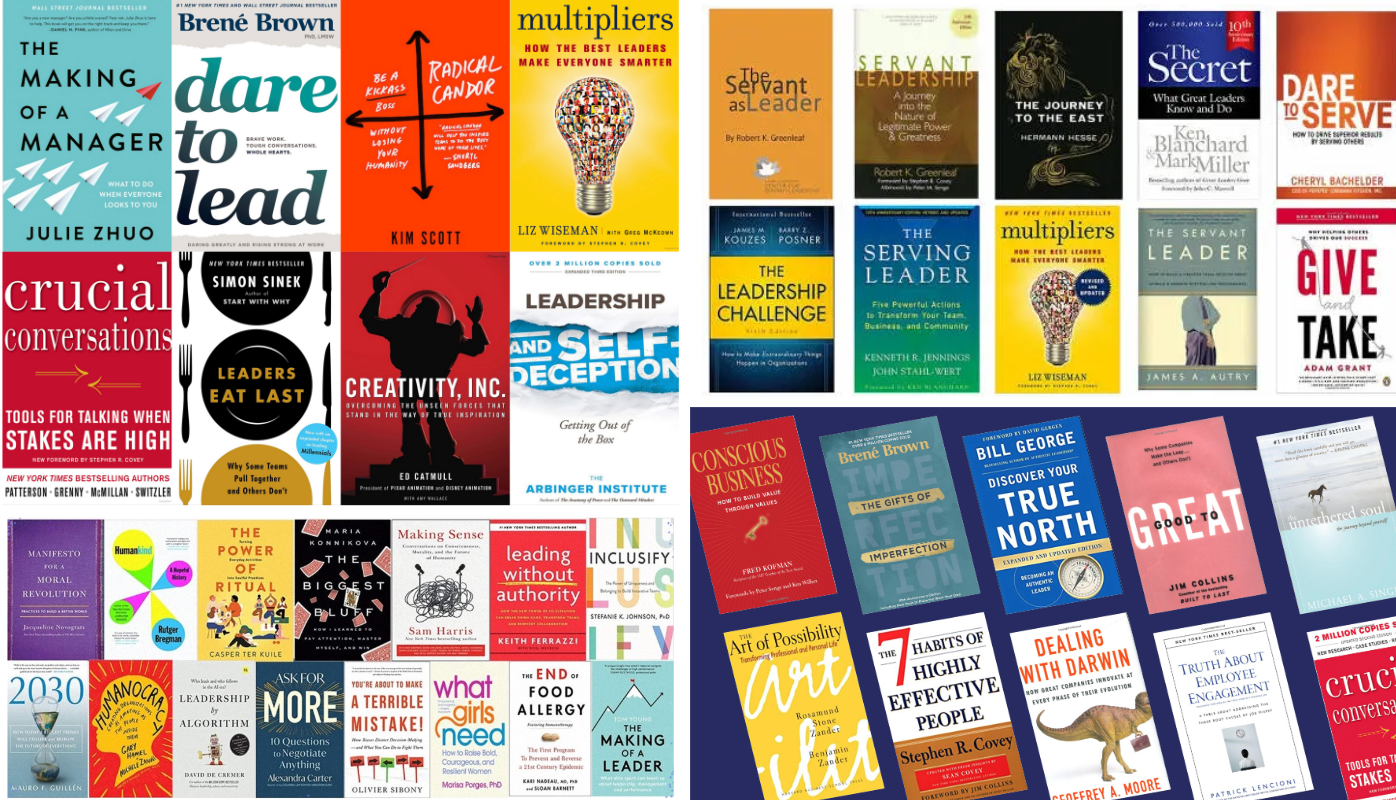
In preparing for this lecture, I noticed that topic of leadership is kind of like the topic of parenting. There are countless books written about it, with a mountain of formulas proposed, each promising that if you just follow that formula, you will raise happy healthy and successful kids or become a great leader. What makes it difficult to know what is the right formula is that neither the topic of parenting or leadership is a perfect science!
There are so many suggested formulas for being a successful leader, and it depends on each individual’s abilities, strengths, experiences, circumstances, or people around them.
I also quickly realized that I can’t really teach you someone else’s leadership formula because the truth is that I never studied leadership from any one person. So the best I can do is tell you the insights I have obtained based on my own experience over the years. My prescriptions and recommendations are not exhaustive, so I would encourage you to continue exploring the topic with other sources, as well as just reflect on your own experiences and draw insights from them.
Over the years, I have come to trust a lot in my own intuition. So I look to the recommendations of others not as strict formulas to follow, but rather as tools to help me understand my own experiences. And I suggest you do the same.
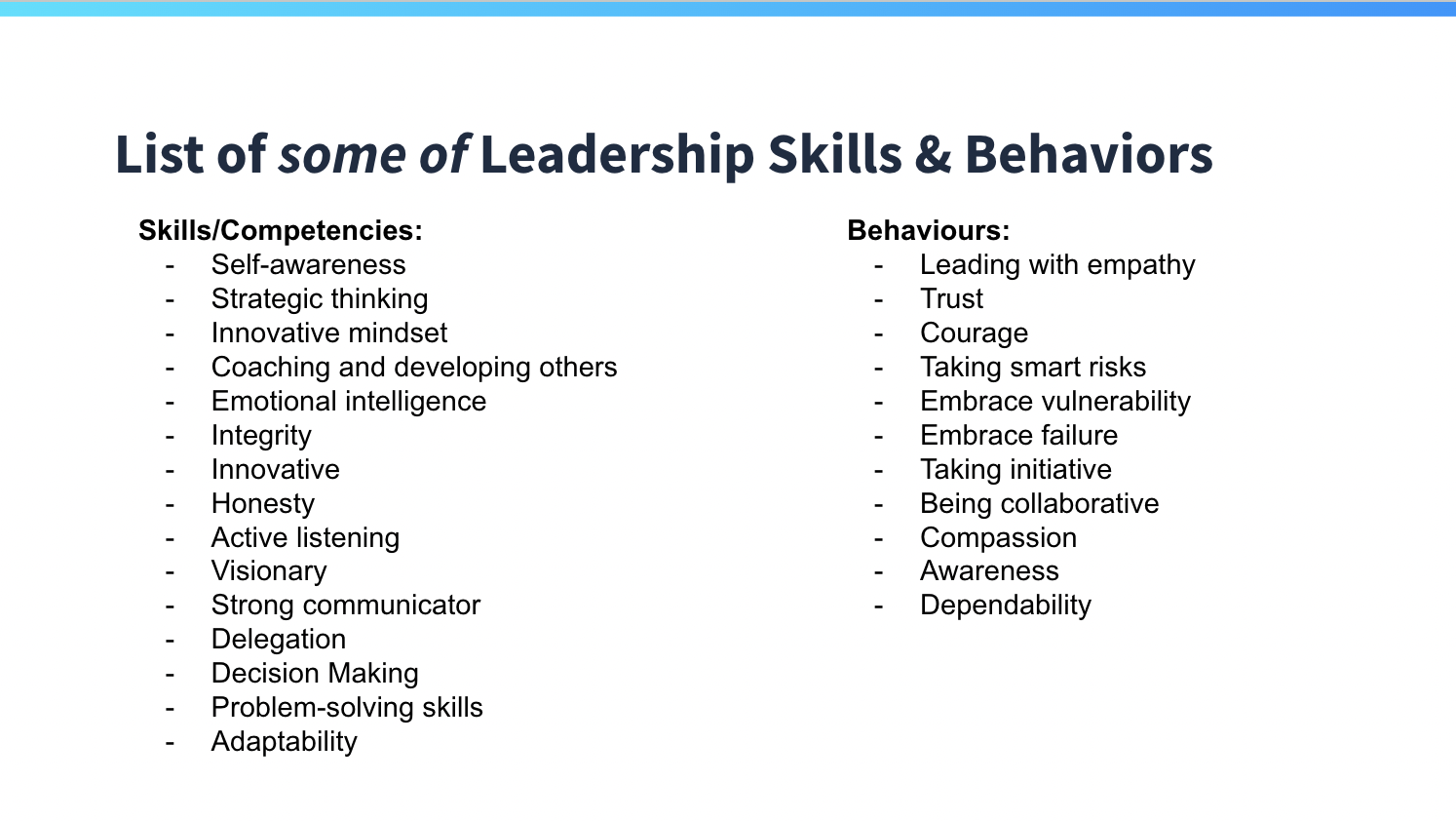
If you go online and read about leadership, there are so many skills and behaviours that are expected from a leader – here is a sample of what I found. They are all valid, but not only it can be overwhelming, but so many of them also are not very actionable. For example, how do you improve on a skill of “Visionary” or “Emotional Intelligence”? Pretty tricky.
In my lecture today I attempted to distill leadership to its absolute basics which will help you understand:
1. What makes a leader?
2. How to become a leader through actionable steps?
Question: What is a leader? Simply put, to my mind, a leader is somebody people follow. Logically, if no one follows you, by definition you aren’t a leader. It’s not really a complicated concept to understand, but a bit trickier to put into action.
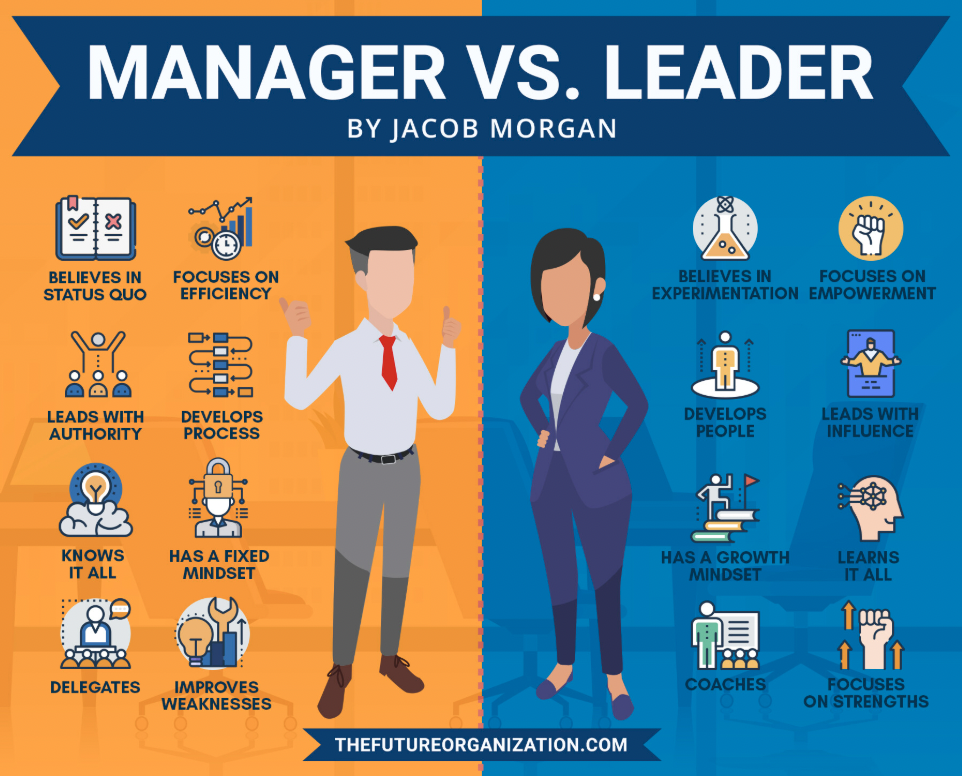
Researching the topic of leadership I found this infographic that attempts to differentiate between a Manager and a Leader, and sets up the argument that the two require fundamentally different (and often opposing!) competencies, and by extension, different personalities.
But what is the real difference between a manager and a leader? Well, a leader is someone people follow, while a manager is a job designation. You can only be a manager in relation to an organization or company, and your role is defined by a set of responsibilities assigned to you by the company. But a leader, isn’t a job description. That’s why you don’t have job openings for a leader on our careers page :)
So it stands to reason that: (1) Not all managers are leaders, (2) Not all leaders are managers, and (3) and some people are both leaders AND managers. If you accept the hypothesis from this infographic that leaders and managers require fundamentally different and opposing competencies, then you might infer that being a good manager means not being a great leader, and vice versa.
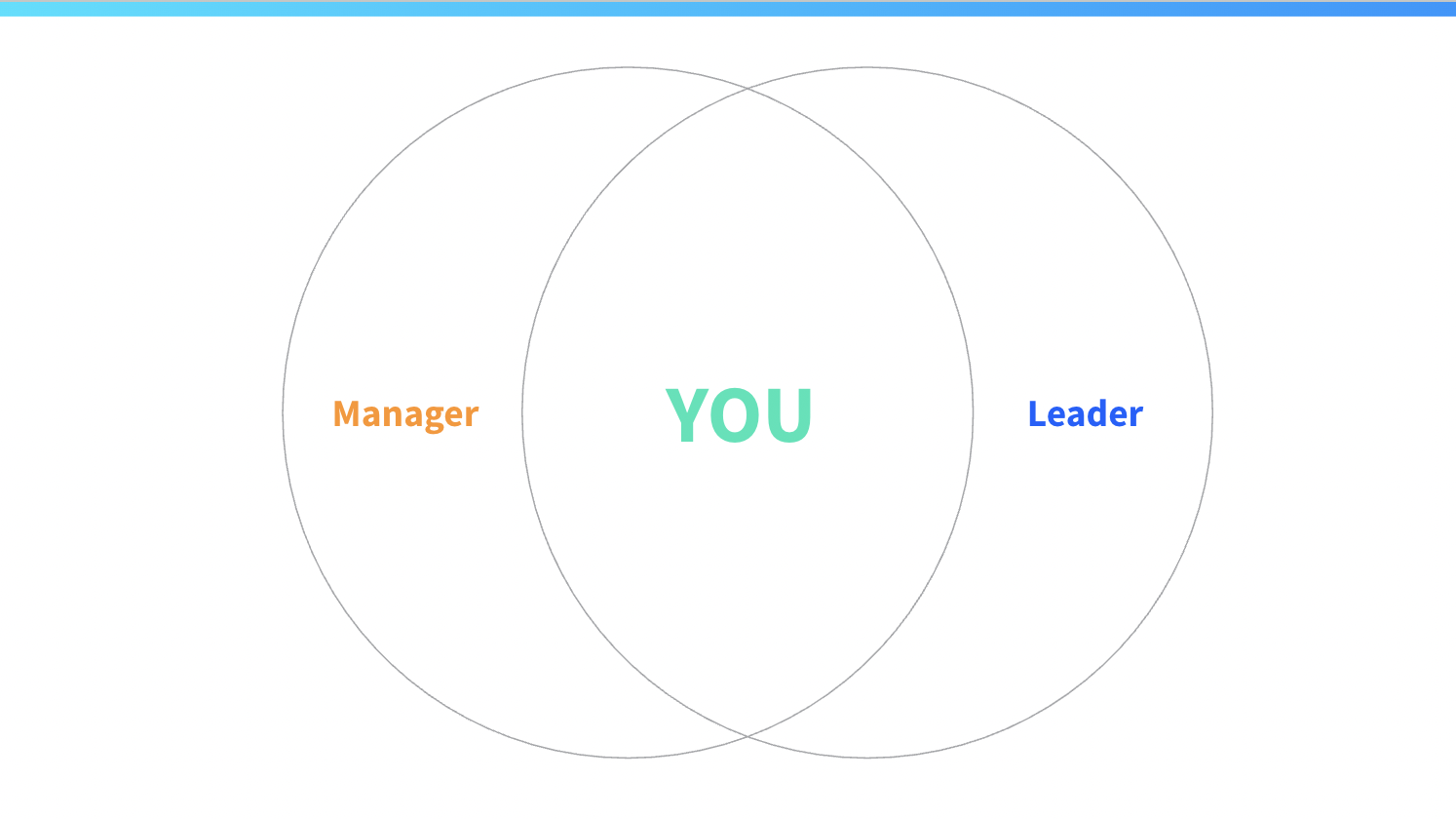
But I would reject this hypothesis, and propose instead that possessing the qualities that makes one a good leader, can assist in making you a better manager, not detract from it. As such, for the remainder of this presentation, I’m going to focus on what makes a good leader, because that is what I was asked to speak about. You will have to decide for yourselves if it helps you be to be a better manager! I am convinced it will.
Going back to the definition of a leader. What makes people want to follow someone? There can be many reasons why a person is followed. In my view, the absolute core reasons are:
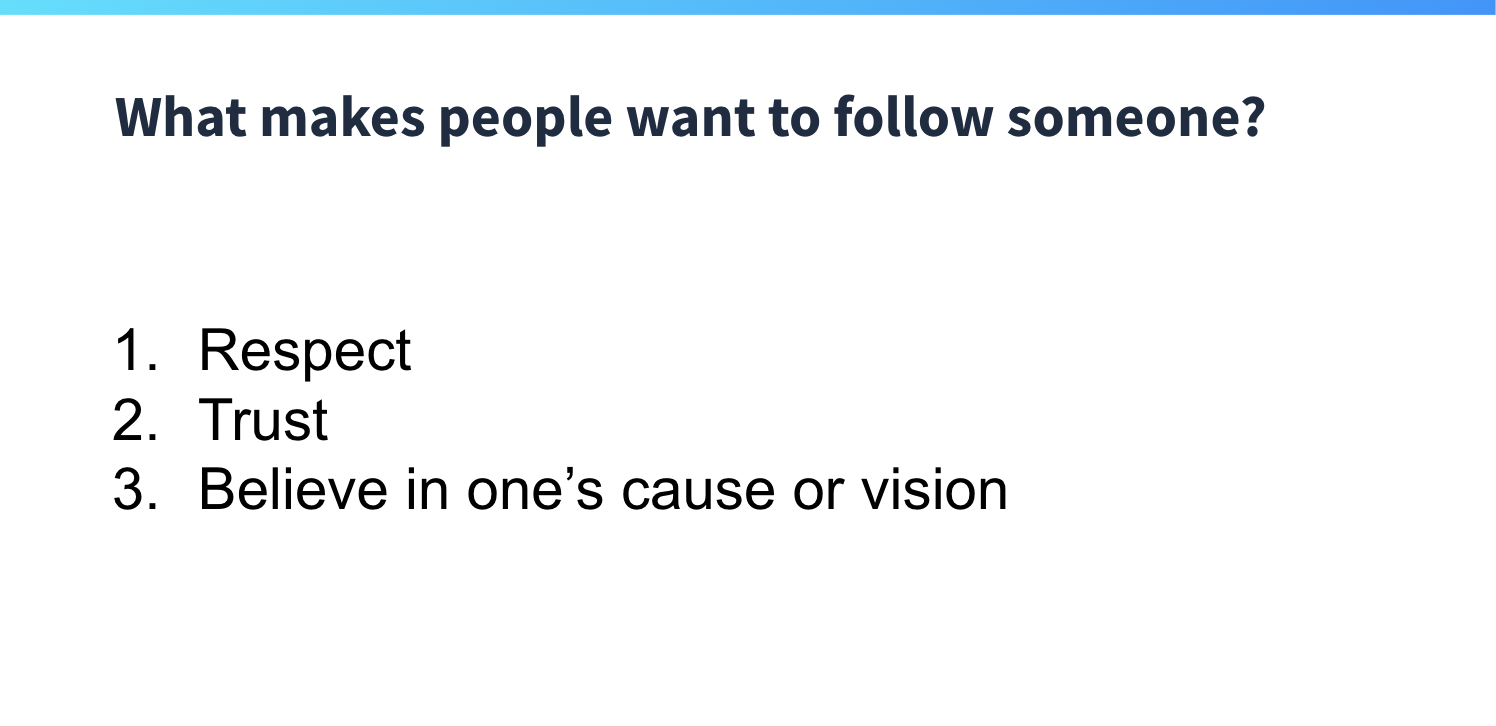
Respect, trust, and belief in one’s mission. These are all necessary conditions, but neither on their own is sufficient. That means that if someone respects you and trusts you, but doesn’t believe in your mission, they won’t follow you. So at least all three are necessary, and there might be others, but these are the three we’ll focus on.
So the next logical question is — how are respect, trust, and belief in one’s mission actually earned?
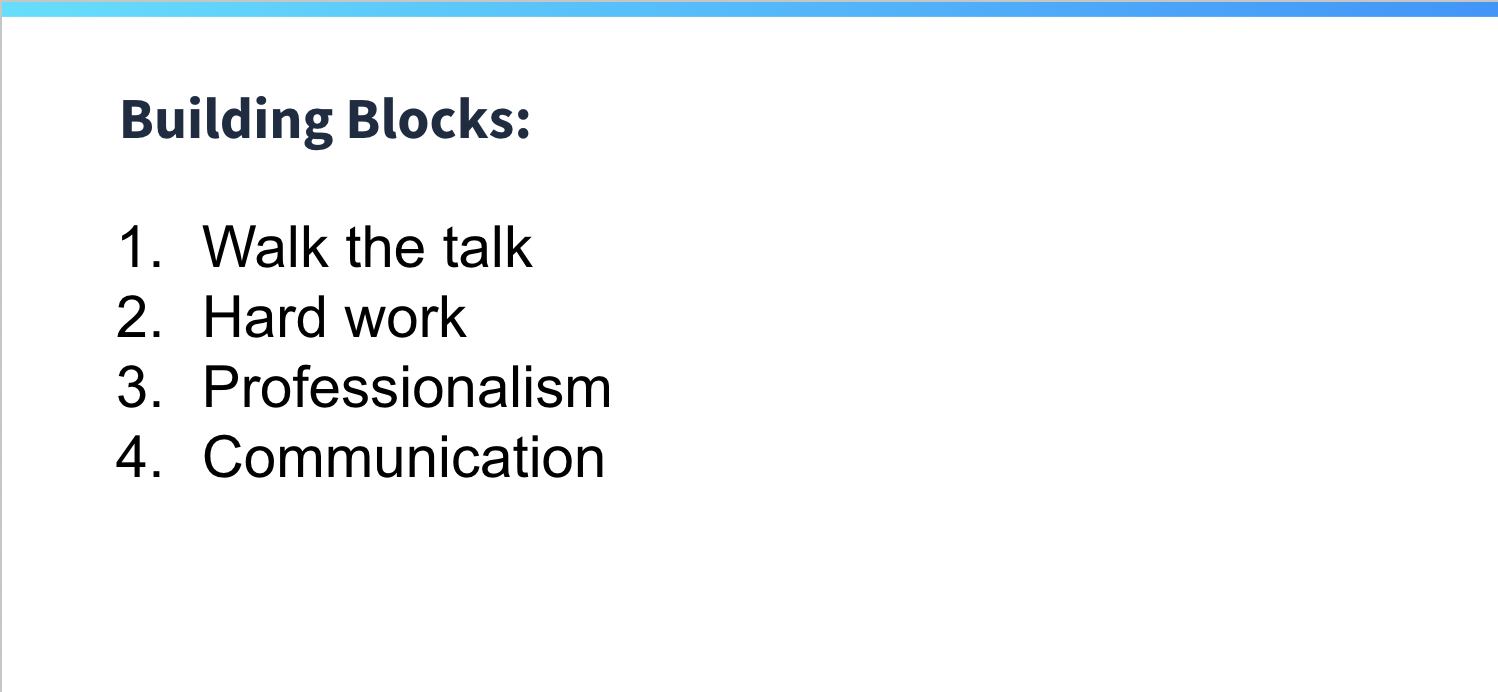
I arrived at these four building blocks that we’ll talk about today – walk the talk, hard work, professionalism, and communication. Practicing these four things will help you earn respect, trust, and belief in your mission.

Let me tell you a story: In the summer of 2014 when Ildar's wife and children went to visit their grandparents, he decided to use the six weeks they were away as an opportunity to work extra hard reaching out to prospective customers. To save time on the commute, he bought an inflatable bed that he kept inflated in one of the closets of our small dingy office on Yonge street in Toronto. Every day, he woke up at dawn to work out and shower at the gym a block away, and he stayed up past the time when the building would turn off all the lights, working in total darkness.
I learned about all this when I came into the office early one day. In the rays of sunlight that were beaming into the office, I saw smoke. I ran to the small kitchenette that was around the corner from the entrance and see Ildar, a giant smile on his face, cooking up a storm on an electric stove that he bought.
When we decided to build this company, Ildar made a commitment to building it into a success and he was always front and center making it a success.
I think it is safe to assume everyone here knows Alexander the Great? He is generally considered to be one of the greatest conquerors in history, establishing domains stretching from Greece to India. He also unified the Western Greek and Eastern Persian empires under a single mandate, language and currency. So you might say he was pretty successful leader.
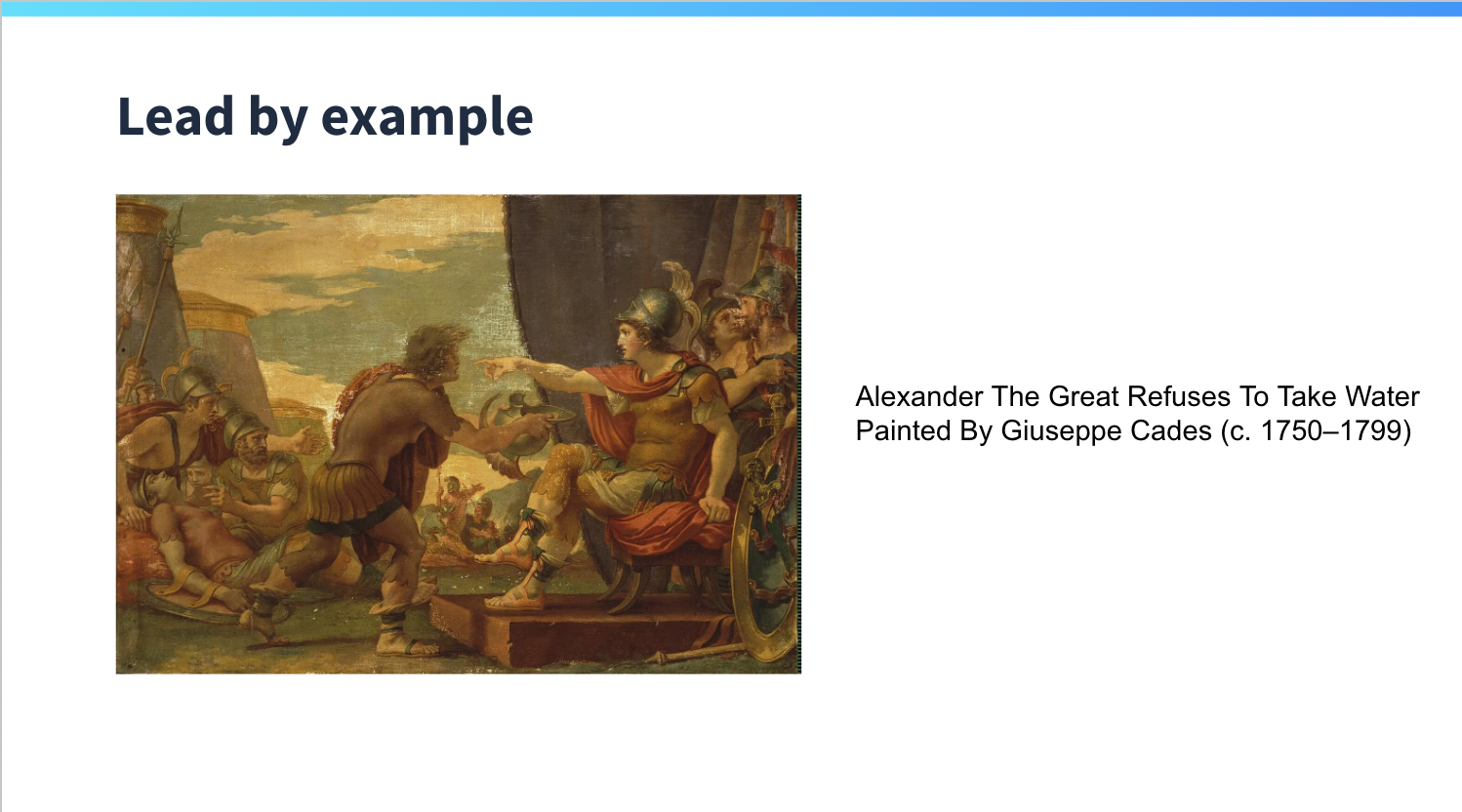
One legend about him has always stuck with me. There is some debate as to if it is true or not, but the fact that it is attributed to him is a testament to the legacy of his leadership style.
During one of Alexander’s early campaigns, while he was chasing the Persian king he led his army through a huge waterless desert. His enormous army and all their animals were suffering horribly from thirst. At one point, a detachment of soldiers came to Alexander telling him they found a small water fountain and had managed to fill a helmet with water and bring it to him. They presented the helmet full of water to Alexander.
Alexander thanked his soldiers for bringing him this gift, and then, without touching a drop, he lifted the helmet and poured the water onto the sand. According to legend, on witnessing this act, a great ovation went up, rolling like thunder through the troops. One man was heard saying, “With a king like this guiding us, no force on earth can oppose us.”
Question: imagine you were in that army - how would you have felt about Alexander after witnessing this?
The lesson here is that a leader must try to be an example to follow for his followers, find a way to always inspire them, and make them feel that a fight is everyone’s fight. That is something that can be accomplished through solidarity.
Now, as a Manager, sometimes it is not possible to do ALL the same jobs as your team will do. But you have to be willing to dive in and help when the help is needed. And your team needs to know it.
Respect is earned when a leader stands shoulder to shoulder with his or her team. Belief in your mission is reinforced through how you show your commitment to your cause. Trust is built because, let’s face it, it's hard to trust a hypocrite….
Question: can someone share a story where somebody walked the talk and that made you want to support their cause?

The second building block is Hard Work.
Let me tell you a story: Has read Tim Ferris’ 4 Hour Work Week? I read it in 2010 and was captivated by the idea proposed in the book — only work 4 hours a week and live the life of your dream! Before I started StackAdapt, I actually tried starting several companies prior to that. The last company before StackAdapt was the company that I tried to start with my best friend. It was a hot July of 2012 and the weather was excellent. To start our startup journey we decided to go to his cottage to have a retreat to launch our company. We spent 2 weeks working. In those two weeks, we swam 3 times a day, we drank two cases of beer a week and spent all in all 2 hours of actual work a day. When we came back to the city, we continued our 2-hour-a-day regiment. A month later we threw in a towel and declared that the market isn’t ready, the product is just too ambitious, and just all odds were against us.
A year later I started StackAdapt with Yang and Ildar, but we took a very different approach. Our motto was FAILURE IS NOT AN OPTION. So we worked all the time. I have put every fibre of my willpower, my energy, and time towards this new company. I thought that if only we work harder than anyone else, we’ll be able to succeed. Nine years later I think I can conclude that it’s a better strategy to becoming successful.
Here is a good quote by Vince Lombardi — who is considered by many to be the greatest coach in football history. “Leaders are made, they are not born. They are made by hard effort, which is the price which all of us must pay to achieve any goal that is worthwhile.”
There is no shortcut for hard work. In fact, as a leader, you should be working harder than people who follow you, because as their leader, you have more responsibility. You are responsible for the mission, and you are responsible for your team.
Question: What comes to mind when I talk about hard work?
When we talk about hard work, I don’t mean working 18 hours a day. Some days, yea, maybe. And on those critical days, yes you need to show up for your team. But that isn’t most days - it’s just not sustainable in the long run.
So let’s talk about sustainable hard work. What I mean, is you need to show up and you need to be seen doing work. Importantly also, you need to use your time efficiently so you don’t just do busy work.
Another critical component to hard work is to not make excuses and spend time explaining why things can’t be done. Instead, work hard and find a way to get things done. You need to be a solutions machine. You need to be the person who climbs the obstacle first. If you have seen the documentary Dawn Wall, the guy who finally managed to climb it was told for 6 years it was impossible. He went back year after year, plotting and experimenting with new routes. Finally, he succeeded! And now people routinely climb it because people know its possible. There is no substitute for the sheer stubborn, and relentless tackling of a problem. A great example is my co-founder, Yang. He is known for breaking through problems that made thought were not possible.
Set an example for people around you, and challenge yourself to do your best work.
Question: Was there a time when witnessing someone’s hard work increased your trust in them, respect for them, or belief in their mission?
There is a lot of talk about the idea of a personal brand on social media. But surprisingly very few people talk about building a personal brand within the company, and this is what matters much more — not just when you are trying to land a new job, but because it impacts your work every single day! I believe that being professional is an integral part of building a strong personal brand. It’s also an important aspect of leadership.
Question: So when I say the word “professional”, which public figure comes to mind? What about that figure makes them seem professional?
Professionalism is a large topic, and there are many different aspects to it that range from the broad and conceptual (e.g. being dependable, being respectful, demonstrating competence, taking responsibility) to the more specific (e.g. being punctual, dressing appropriately, good organizational skills). For today, I want to talk specifically about maintaining a courteous and respectful attitude, and eliminating what I have learned to be unconstructive behaviour.
There is definitely a perception in the workplace that you need to be tough to be a successful leader, but unfortunately, many people interpret this as a call to action to be rude. They correlate politeness with weakness, and toughness with rudeness, often dressing it up as “telling it like it is”. I think this is just an excuse to not master your emotions and your communication skills. You can be firm but polite.
This is the time to eliminate these behaviours in yourself, and encourage others to eliminate them as well.
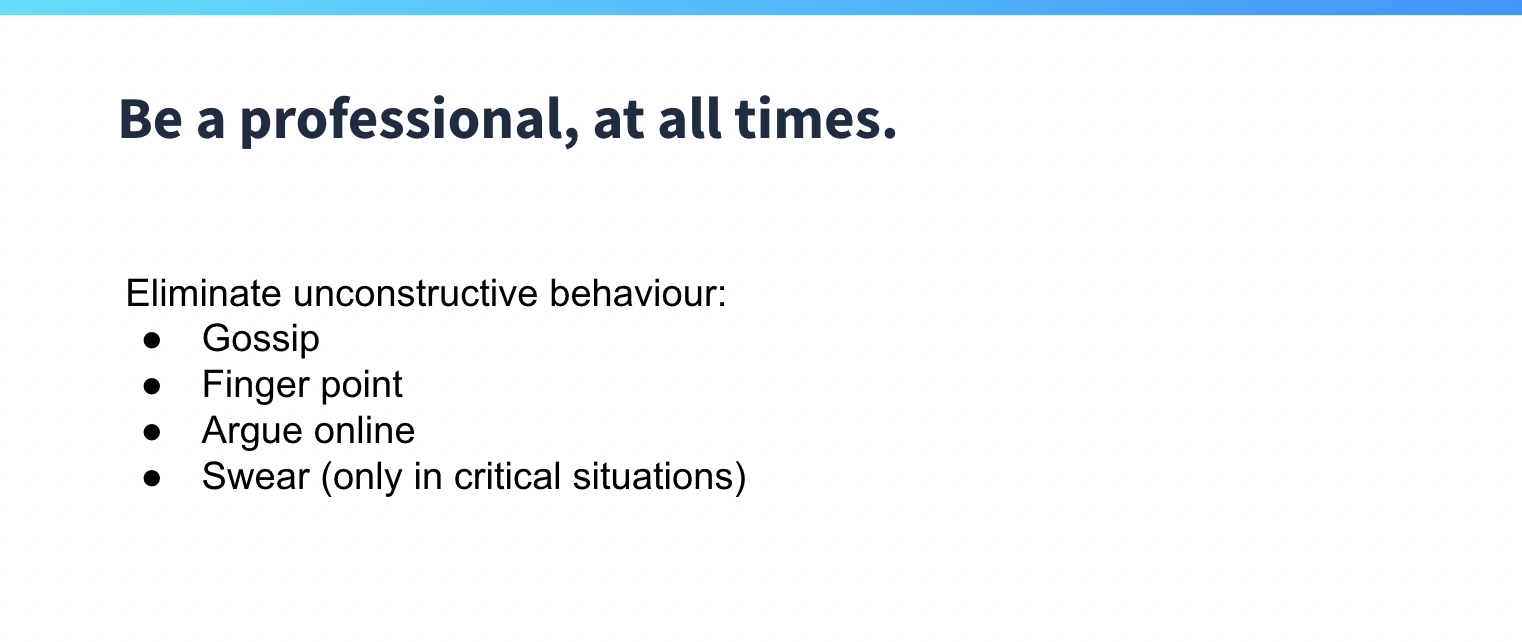
I will start with a big one. Leaders need should not gossip about others. It’s really not a good look because it ruins the other person’s reputation and you can lose trust with people to have an honest conversation because they may worry you talk about them with someone else.
Don’t finger-point and play the blame game. It’s not actually helping anyone and an easy way to lose respect. Be the person who steps in to own and fix issues – trust me it doesn’t go unnoticed. People who dodge responsibility lose trust and respect very quickly. Being a leader means taking on responsibility. Dodging the responsibility, weakens your leadership position.
Try to avoid swearing. Even in positive situations, it carries a lot of aggressiveness and can deliver a wrong message, especially to people who come from different cultures.
Lastly, really avoid arguing publicly, especially publicly online. Since most of our communication is online and on social platforms like LinkedIn, stay away from online drama and bickering. I get my share of nasty messages online once in a while— just ignore it. Smart people see right through all this stuff. Rise above all that petty nonsense. If you do want to respond, I suggest taking time to think about it and talk to someone, and not respond in rage. 9 out 10 times your response would improve by virtue of taking time to think about it.
The last building block is communication.

Question: can you think of a person who is a great communicator, and what makes them a great communication?
Believing in one’s mission is directly tied to communication – without it, how do you communicate the mission? Clear communication also happens to be a core aspect of managing expectations. There are two parts to communication.
To the first, clear articulation and communication comes ONLY WHEN when you truly understand the issue. That issue could be a subject, topic, and in the contect of management, often it is an expectation or a goal. But without a fundemental, clear and logical understanding of the expectation or goal, you have no hope in communicating it clearly. For example, to be good at communicating company strategy, or your team strategy, it starts with you understanding it.
To the second, I have learned that good communication is a byproduct of preparation and practice. Any time I have to make a presentation or a public speech, I write out the entire presentation word by word, and practice it until I know it. This also helps me check my own understanding.
As a leader, you want to champion the culture of the company. This is where you need to reflect on whether you a). know the values b). understand the values c) and exhibit those values. For people to believe in your mission you need be able to show you understand it first.
As a bonus, I wanted to share a couple of thoughts on the general attitude you want to have as a leader. Here is a good motto to live by, from an English actor Michael Caine. “Be like a duck. Remain calm on the surface and paddle like hell underneath.“ I’ve said it before and say it again, businesses are just people and people often make things pretty hectic. Your ability to stay unphased in the face of chaos in front of your team is very important.
Here is a quote from Jason Lemkin who runs SaaStr and previously sold EcoSign to Adobe. It touches all many of the concepts we went over above.
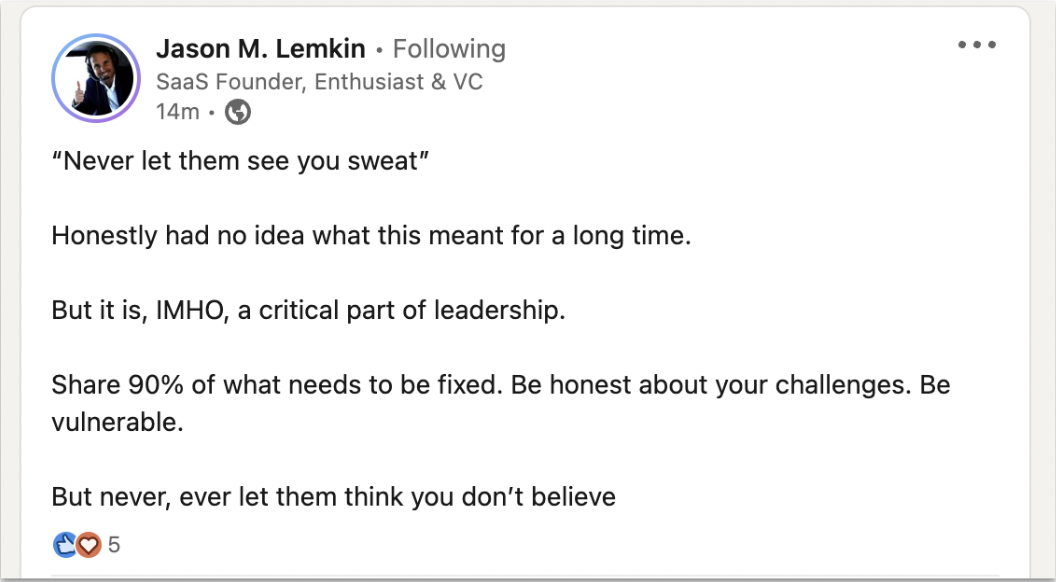
You need to be the first person that believes in the mission you are on, otherwise it will be very hard to expect anyone else to follow you.
What next?
At the beginning of this lecture I promised I will share actionable steps that you can start taking today. Leadership is inherently linked with taking action so we need to identify easy things you can do this week to get in the leadership mindset. What can you do today?
Help others succeed - this is something I tell everyone who joins the company. Welcome new folks, help them ramp up – it’s such a powerful way to stand out and pay it forward.
Find ways to champion the culture. Build that network and grow number of people who champion you from within the organization. To be successful you need to know a lot of people who will help you take on bigger and bigger projects! And just engage with virtual life of the company – share content on social, give kudos and so on. Those small things matter.
Get involved - volunteer and participate in events, and show up, especially for your teams!
After that, just keep the momentum going. Doing small actions compound over time — consistency is key here!
The job growing is never done. So good luck on your journey of becoming a better leader!